Tuesday, September 22, 2026

Mitsotakis diplomacy of damage control

Damage control is not diplomacy. It is what governments do after diplomacy has already failed. That distinction matters in the increasingly complicated relationship between Greece and Turkey, where every carefully staged handshake risks becoming another exercise in managing yesterday’s problem rather than preventing tomorrow’s crisis. And this is precisely why Kyriakos Mitsotakis’ non-schedule meeting with Recep Tayyip Erdoğan in New York deserves more scrutiny than the choreography of another stand-in photo.

The disturbing part is not that the Greek PM is meeting Erdoğan. Of course he should. Neighbours with a history of disputes, competing interests and overlapping ambitions have to talk. The disturbing part is the apparent absence of a sufficiently defined agenda. Diplomacy without an agenda can easily become diplomacy by improvisation and improvisation is rarely a sensible strategy when dealing with a leader who understands leverage considerably better than he understands restraint.

Erdoğan has spent years constructing Turkey as a regional power whose influence stretches far beyond its borders. He has combined military power, economic relationships, migration, energy, diplomacy and geography into a foreign-policy toolbox that gives Ankara options. Turkey does not need every option to be used. The mere existence of those options creates leverage.

Greece, by contrast, too often appears trapped in a reactive diplomatic rhythm; tension rises, European partners become nervous, Washington encourages dialogue, Athens seeks de-escalation, Ankara signals flexibility, a meeting is arranged and everybody congratulates themselves on having prevented a crisis. Then the cycle begins again.

That is not a strategy. It is a fire brigade. The problem with permanent damage control is that it gradually changes the balance between the parties. The side that creates uncertainty acquires bargaining power; the side constantly trying to restore stability becomes responsible for maintaining it. Eventually, stability itself becomes the concession.

This is where Mitsotakis needs to be particularly careful and sadly he literally …fails. There is nothing inherently wrong with dialogue. Indeed, refusing dialogue between Greece and Turkey would be reckless. But dialogue has value only when it serves a clearly defined diplomatic purpose. A meeting should establish what can be discussed, what cannot be traded away, what constitutes progress and what happens when commitments are ignored. Otherwise the meeting risks becoming another ritual in which the existence of dialogue is mistaken for the achievement of diplomacy.

Erdoğan understands political theatre. He understands the symbolism of presidential meetings, the language of strategic patience and the usefulness of appearing reasonable while keeping multiple avenues of pressure open. Calling him a regional superpower may be premature; calling Turkey an increasingly consequential regional power is simply recognising reality. Ankara wants influence and it has repeatedly demonstrated that it is prepared to pursue it.

That does not make Turkey an enemy. Nor does it make Erdoğan an inscrutable mastermind with a secret plan behind every curtain. But it does mean that Greek diplomacy should stop behaving as though good intentions automatically produce balanced negotiations.

Athens needs its own leverage. That means European solidarity cannot remain a ceremonial phrase. It means alliances must be converted into practical diplomatic capital. It means Greece needs clearly articulated red lines, but also clearly articulated areas where cooperation with Turkey is possible. And above all, it means Greece should enter negotiations knowing precisely what it wants, not merely hoping to prevent what it fears.

There is a dangerous psychological trap in diplomacy: believing that because nothing exploded today, something was achieved. Nothing exploding is not necessarily progress.

A successful Greek-Turkish relationship cannot be built on endless emergency management, carefully worded communiqués and photographs from meetings whose substance disappears before the aircraft lands.

Mitsotakis can meet Erdoğan in New York. He should talk to him. But Athens should not confuse access with influence, conversation with negotiation, or calm with resolution.

Diplomacy is not the art of making every crisis disappear from tomorrow’s newspapers. It is the art of ensuring that the next crisis begins with fewer advantages for the other side. That requires an agenda. And, more importantly, it requires a strategy.

* * * * * * * * * *

Published in Ovi magazine and across diverse print & digital platforms.

Sunday, September 20, 2026

The Swedish far-right didn’t …exactly lose


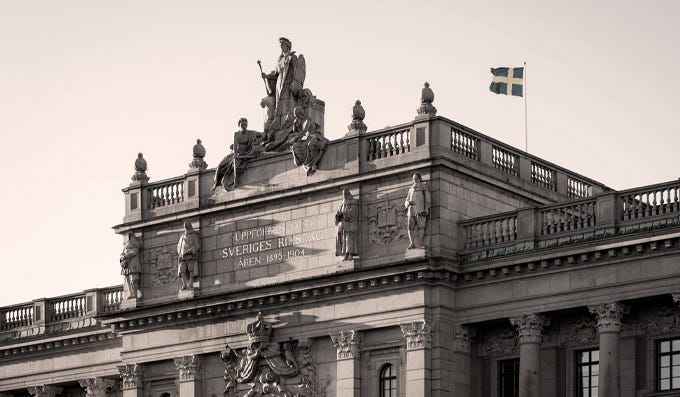
Ulf Kristersson has left office, the centre-left has squeezed through the electoral door and Magdalena Andersson is preparing to return to Rosenbad. Sweden has changed government, but it has not necessarily changed direction.

The arithmetic is almost comically Swedish: 176 seats for the centre-left bloc, 173 for the right. A majority so narrow that one might be tempted to measure it with a ruler. Kristersson has accepted the result and resigned, as parliamentary democracy requires. The Social Democrats can celebrate. The champagne may even be poured.

But nobody should confuse an electoral defeat with an ideological defeat. The Sweden Democrats lost seats and slipped from second to third place, their first decline in national support since entering parliament in 2010. That matters. But the more interesting question is what remains after the electoral furniture has been rearranged. For four years, the Sweden Democrats were not simply shouting from the political wilderness. They became central to the governing arrangement, helping define the political vocabulary of Sweden on immigration, crime, integration and national identity.

And political vocabulary has a nasty habit of surviving the government that popularised it. This is the great paradox of the Swedish election. The centre-left has won, but much of the political terrain on which the election was fought had already moved rightwards. Immigration became a problem to be managed rather than primarily a human and social question. Crime became a political currency. Integration was increasingly discussed through the language of obligation, control and punishment. The old Swedish argument about how to build a society was gradually replaced by an argument about whom society should distrust.

Changing the government does not automatically change that atmosphere. There is an even more uncomfortable problem. Far-right politics is no longer dependent upon spectacular electoral victories. It can lose an election and still win something more durable: normality.

This is particularly important among younger Swedes. Political movements become dangerous when they stop looking dangerous. A teenager encountering the Sweden Democrats on a social-media feed does not necessarily encounter their historical baggage, ideological evolution or controversies. He or she encounters a meme, a joke, a furious video about crime, a complaint about taxes and a declaration that politicians have forgotten ordinary people. Politics arrives disguised as entertainment.

The algorithm is wonderfully democratic in the worst possible sense: it does not care whether an idea is wise, humane or historically literate. It cares whether somebody will click.

And young people click. The far right understands this environment rather better than many traditional parties do. It knows that political recruitment does not always begin with a manifesto. It can begin with resentment, humour, irony, masculinity, cultural grievance or the apparently harmless question of why everything used to be better. By the time the political label appears, the emotional architecture may already be built.

That is why Sweden's centre-left victory should not become an excuse for political sleepwalking. Andersson inherits a country in which the traditional parties themselves have spent years arguing over how far to accommodate the anxieties that propelled the far right. If the response to the election is merely to reverse a few policies, restore a few subsidies and declare democracy victorious, the deeper problem will remain untouched.

Democracy is not a four-year cleaning service. It requires schools capable of teaching history rather than merely testing memory. It requires journalism capable of challenging propaganda without turning every controversy into theatre. It requires politicians who can discuss immigration without either romanticising its difficulties or weaponizing them. And it requires young citizens to be given something more substantial than perpetual outrage to believe in.

The Swedish far right may have lost this election. That is a fact. But it has already demonstrated that political influence does not require occupying the prime minister's office. Sometimes all that is required is to make everybody else speak your language.

That is the part Sweden should worry about. Because governments change rather quickly. Political habits do not.

* * * * * * * * * *

Published in Ovi magazine and across diverse print & digital platforms.
The idiots who keep opening the door to fascism in Greece

From television studios to football terraces, from Cyprus to Greece, the grotesque political resurrection of Ilias Kasidiaris is becoming an...